1982 saw the arrival of Rob Taylor managing the Chicago Stockyards taking over for (now sadly departed) Dale Smith. Dennis Jennings grabbed first placed for the second time in three years but it was the second place Chicago Champions behind Tedd Mallasch who won the IAL championship in 1982. They had the homerun leader in IAL MVP Mike Schmidt (41) and the batting champ in Mike Hargrove (.318). In addtion, Jim Rice (28 HR, 109 rbi) lent a hand. Cardinal hurler Steve Carlton won the Cy Young and for good reason. He hit the trifecta leading the IAL in wins (24), ERA (1.69), and strikeouts (266). Carlton’s 1.69 ERA remains the second lowest all-time to this day. Record performances in 1982 (and rank all-time):
Steve Carlton
Northeast Cardinals
1.69 ERA
2nd
Steve Carlton
Northeast Cardinals
24 W
3rd
Cecil Cooper
Chicago Stockyards
61 2B
4th
Tim Raines
Davenport Fire
104 SB
5th
Dick Drago
Northside Hitmen
104 G
1st
Fernando Valenzuela
Northeast Cardinals
8 Sho
2nd
My Steve McCatty Story After my Geneseo Athletics placed last in 1981, the league, in its infinite wisdom, passed a rule, which allowed a team that placed last two years in a row to pick any player in the MLB in lieu of any player on their team. We called it the “Loser’s Pick”. This was a retroactive rule and my team qualified for this new rule. I could have ANY player not already on an IAL team. The field was open! I could pick any superstar, any proven player, anyone with lots of potential. A franchise player to build a team around. So who did I pick? Steve McCatty. Granted, he was an A starter that year. I had Bob Knepper already. He was also an A and I was so focused on what it would be like to have a one-two punch like that. One can’t fault my fellow managers in the IAL. One by one they tried to convince me that maybe “Cat” wasn’t the pick for me. Maybe a middle infielder or a proven big bopper who would be around for years to come. But I wouldn’t listen and Steve McCatty became an Athletic. What happened? Well, McCatty actually had a great year for me in 1982. He went 16-8 with a 2.11 ERA. His 2.11 ERA remains 9th all-time on the single season list. We didn’t make the playoffs though finishing 6th with a 77-84 record. But I betcha we had the best dang ERA in the league (actually 3.50 ranked 5th). McCatty declined after his initial season. He was a CZ the next season and a DW the one after that. I think that was all the IAL could take of the “Cat”.
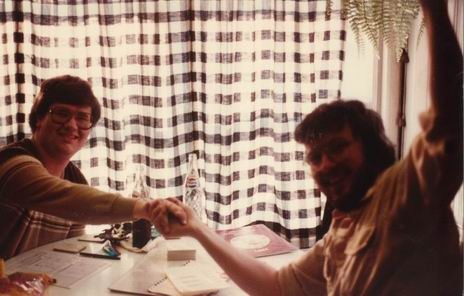
Mike Bunch congratulates Chuck Lucas after the Hitmen win the IAL title in 1981
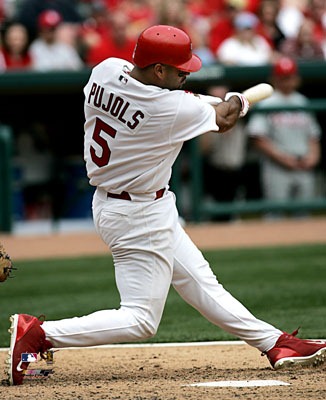
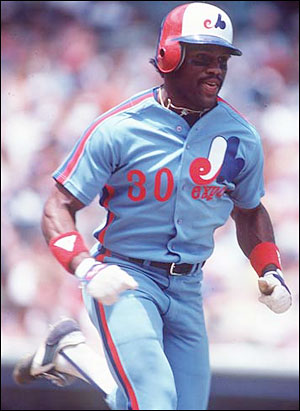
1981 was a year of firsts for the IAL. It was the first time Chuck Lucas won the IAL Championship defeating the East Moline Bombers in the World Series. It was the first time a reliever both won and saved 20 or more games as Cy Young winner Doug Corbett led the league with 22 wins and also saved 20. It was the first time an MVP player came from a non-playoff team. Al Oliver, playing for the 5th place Northeast Cardinals, won the award by hitting .352 and driving in 138 runs.
1980 was the beginning of Dennis Jennings’ Thunderchicken dynasty as they captured first place three times in the next 6 years. In 1980, they did everything right, winning 103, capturing the Illowa championship. In addition, Steve Garvey won league MVP hitting .330, driving in 122, & scoring 114 runs. The Thunderchickens also had the top two in ERA (Bruce Kison with 2.56 and Ron Guidry with 2.73), but lefty Tommy John led the way with a 20-11 record.
But the big bopper in the league was East Moline Bomber outfielder Gorman Thomas. Thomas banged out 57 homeruns that year. Not only that he led the league in runs (131), slugging (.645), and walks (109).
Davenport Fire pitcher Dennis Martinez won Cy Young award based on his league leading 22 wins and a 2.84 ERA.
After the season ended Tedd Mallasch attempted buying Gorman Thomas from Mike Bunch by giving him a fifty dollar bill, it took alot of time & effort to recover the money.
1979 was a year in which the Chicago Champions, largely helped by outfielder Jim Rice, took it all. They garnered first place missing the century mark by one win and won the World Series. MVP Rice quite simply dominated the league. He belted 66 homeruns, an IAL record that would stand for 17 years. He also led the league in runs (129), rbis (125), and slugging pct (.622), batting leadoff much of the year, incredibly he had nearly 40 at bats left unused. The Maquoketa Cardinals’ Al Oliver won the batting title with a .326 mark. Cardinal Bob Knepper won Cy Young honors due to his 1.97 ERA and 21 wins, including nine shutouts.
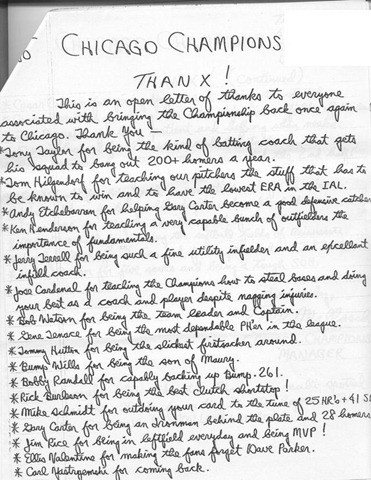
Take a look a couple of articles from 1979 newsletters (below, click to enlarge). I wish I could include them all. I have Tedd’s because after all, he won it all. I also included Don Smith’s since not only does he have a penchant for writing well, his article also includes a lot of history of the IAL from that time.
The race for first place in ’78 was a tight one as the Fire beat out the Champions by two games. With MVP and home run king Greg Luzinski and Cy Young reliever Sparky Lyle the Fire squad was a powerhouse. Luzinski totaled 104 homeruns for the past two years. For the year, he had 58 along with 129 rbis. Newly acquired Sparky Lyle had 23 saves with a 2.33 ERA. Despite leading the league in wins (24) & ERA (2,26) Lefty Steve Carlton was snubbed in postseason Cy Young Award voting, due to a perception by voters that he was matched up against bad starters.
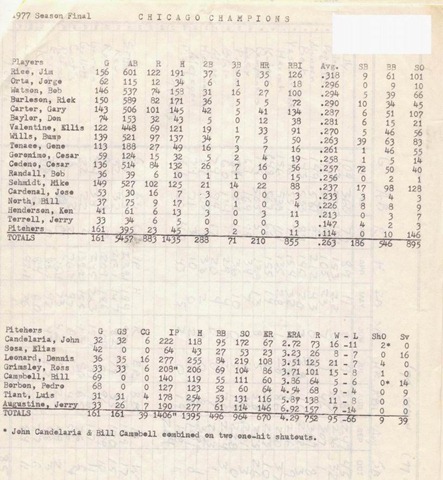
Alas, it was the Chicago Champions who prevailed in the post-season and won the World Series (see a scanned image of Manager Tedd Mallasch’s final stats from the original 1978 newsletter at right).
Here is Tedd Mallasch’s account of what went down in ’78:
TWO OUT OF THREE AIN’T BAD…
For the 2nd time in his three years at the helm Manager Mallasch guided the Chicago Champions to the Championship. The Champs finished two games behind the Davenport Fire, but put it altogether in the playoffs to capture the title. Interesting note that these two teams pulled off a blockbuster trade before the season, the Champions sent 1978 MVP Greg Luzinski to the Fire in exchange for a young catcher Gary Carter. Carter would have a monster year for the Champs leading the team in 2B’s, HR’s, & RBI’s (42,41,134). Luzinski never played for the Champs as the trade was actually a three way deal involving the Bombers. The Champs were a powerhouse launching 210 longballs, Jim Rice 35 and Ellis Valentine 32 were the only other hitters to belt more than 30 home runs as the lineup featured power up & down the order. Workhorse Dennis Leonard completed 16 of his 35 starts finishing with a 21-7 record. Elias Sosa was the team’s closer figuring in 24 victories in the 42 games in which he appeared.
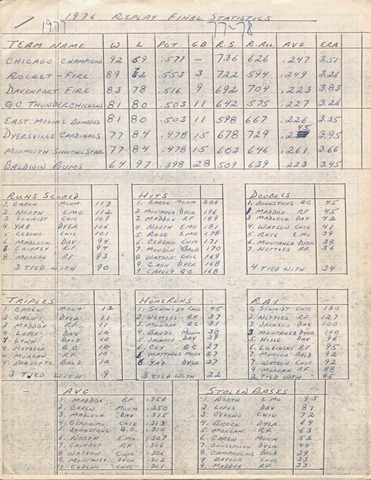
In 1977, Dennis Jennings and his Quad City Thunderchickens (81-80) won his first IAL championship, after winning a one game playoff game versus the Bombers to make it into the playoffs, with the help of Jay Johnstone and Rick Monday and the arm of Mark Fidryrch. Tedd Mallasch and his Chicago Champions garnered first place behind bat of MVP thirdbaseman Mike Schmidt who led the league with 45 homeruns and 130 rbis. Rocket-Fire outfielder Garry Maddox picked up the batting title with a .356 batting average, teammate Graig Nettles, using BIG DICE (squares cut from a fence post by Dale Smith’s father) finished 2nd in the league in home runs with 37, also finishing 2nd in RBIs with 127. On the pitching side of things, Cy Young winner Ferguson Jenkins led the league with a 2.43. Amazingly, reliever Rollie Fingers led the league with 21 wins. That’s even more of a feat considering his Maquoketa Cardinals only won 77 games for the years.
I’d like to share with you a couple of interesting happenings. Champs outfielder Cesar Geronimo hit two homers in 464 at bats, back-to-back versus the Cardinals. In another game against the Cards, the Champs were up 4-0 in the 1st inning of a ballgame, two outs, bottom of the first, runners on 2nd & 3rd, with the pitchers ondeck, the 8th place hitter was walked to get to the pitcher, Don Groove Baylor came off the bench & hit a grand slam!